
Online Store for Small and Medium Business in India: A Practical Guide
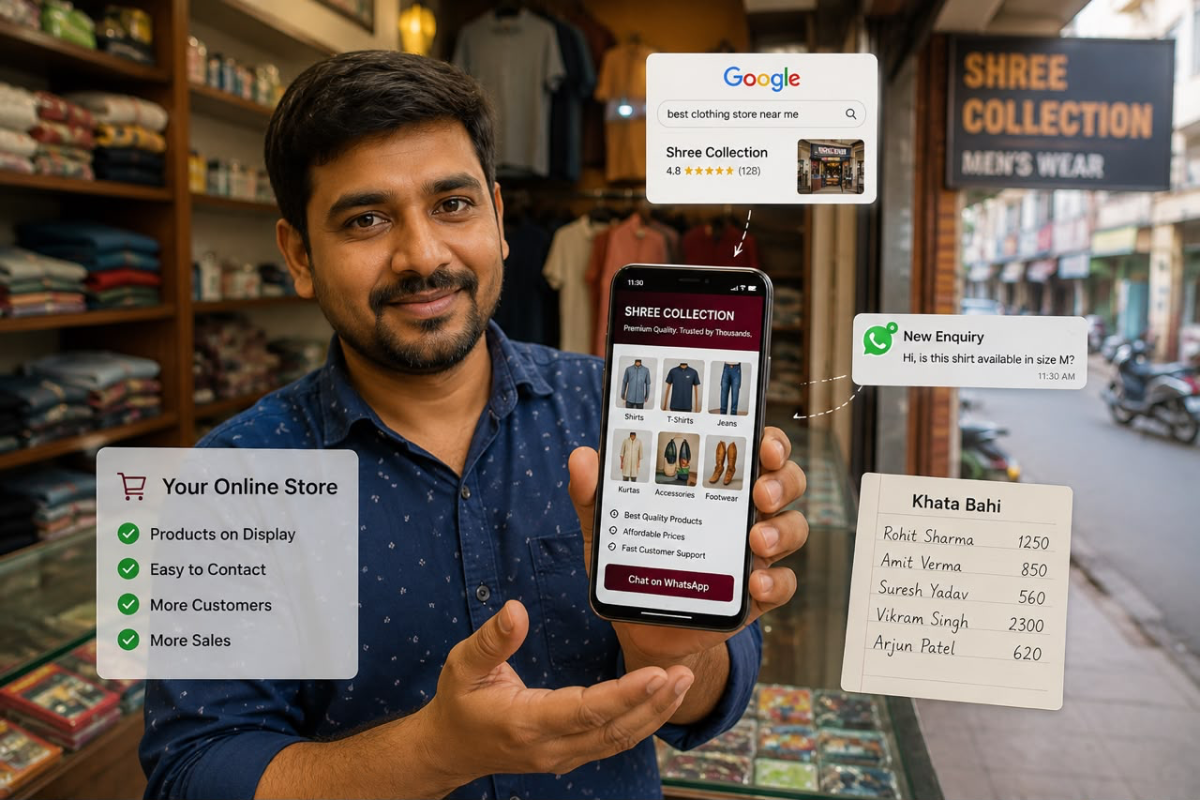
Your Shop Is Local. Your Customers Don’t Have to Be.An online store for a small business can help a local shop showcase its products, get discovered o...
Vyaparies Team
Retail & Growth Experts
Your Shop Is Local. Your Customers Don’t Have to Be.
An online store for a small business can help a local shop showcase its products, get discovered online and turn customer searches into conversations and sales.
Imagine a customer living two kilometres from your shop.
They need a kurta, a mobile accessory, a salon appointment, or even a few grocery items.
They pick up their phone and search Google.
Your shop may be excellent. Your prices may be competitive. Your customers may trust you for years.
But if your business barely exists online, that customer may never know you are there.
This is the real problem for many Indian small businesses.
It isn’t necessarily that customers have disappeared. It is that the way customers discover businesses has changed.
For a local shopkeeper, this creates an important question:
Do I need to become a big e-commerce company just to have an online presence?
No.
For most neighbourhood businesses, the smarter goal is much simpler: create a useful digital version of the business you already run offline.
That means a place where customers can see what you sell, understand your business, find you, ask questions and contact you easily.
That is where an online store for small business becomes useful.
Why Your Offline Shop Needs an Online Counter
A physical shop has a simple advantage: customers can walk through the door.
Online, they need another way to “walk in.”
Your website or online shop can act like a digital entrance.
A customer should be able to quickly answer:
What does this business sell?
Where is it located?
What products or services are available?
Can I contact the owner?
Can I ask about price or availability?
Does this business look trustworthy?
How can I visit or buy?
For a kirana store, this could mean displaying popular products and accepting WhatsApp enquiries.
For a salon, it could mean showing services, photos, timings and contact details.
For a boutique, it could mean displaying clothing collections and encouraging customers to enquire on WhatsApp.
For a doctor or independent professional, it could mean presenting services, location and appointment information clearly.
Notice what is missing.
You don’t necessarily need thousands of products, warehouses, complicated logistics or a nationwide delivery network.
You need visibility and convenience.
What an Online Store for Small Business Should Actually Do
A common mistake is thinking that an online store simply means putting product photographs on a website.
That is only one part of it.
A useful small-business digital presence should bring several pieces together.
1. A Proper Digital Shopfront
Your business should have a central place customers can visit online.
Think of it as your digital shop board.
It can contain your business name, location, phone number, WhatsApp button, products or services, photos, about section and other important information.
Instead of repeatedly sending the same details to every customer, you can send one link.
2. A Good Product or Service Catalogue
People often want to browse before contacting a business.
A catalogue makes that possible.
For example, a clothing shop could show:
Shirts
Kurtas
Trousers
Sarees
New arrivals
A salon could show:
Haircut
Hair colouring
Facial
Bridal packages
Hair spa
The catalogue doesn’t just look professional.
It saves time.
A customer can look first and ask questions later.
3. WhatsApp as the Bridge to Sales
This is particularly important for Indian local businesses.
Many customers are comfortable asking:
“Bhaiya ye available hai?”
or
“Iska best price kya hai?”
over WhatsApp rather than going through a complicated checkout process.
That makes WhatsApp a powerful bridge between your online presence and your actual shop.
A good setup should make contacting you easy.
One tap should take the customer towards a conversation.
Google Visibility Matters More Than Many Shopkeepers Realise
Having a website does not automatically mean customers will find you on Google.
This distinction is important.
Your website and your Google Business Profile serve different purposes.
Google Business Profile can help a local business appear in Google Search and Google Maps with information such as its name, location, hours, phone number, photos and reviews.
Your website can provide a deeper experience.
For example:
Google Search → Business Profile → Website → Catalogue → WhatsApp enquiry
That journey is powerful because the customer moves from discovery to action.
But don’t fall for the promise that simply creating a website will guarantee Google rankings.
Local visibility depends on many factors, including relevance, business information, prominence, customer experience and the quality and accuracy of your online presence.
The sensible goal is not:
“I must rank #1.”
The sensible goal is:
“When someone searches for what I sell in my area, my business should have a credible chance of being discovered and trusted.”
The Digital Khata Problem: Visibility Alone Isn’t Enough
There is another reality of Indian small businesses.
Getting customers is one challenge.
Managing those customers and transactions properly is another.
Consider a local shopkeeper who sells on credit.
One customer owes ₹1,800.
Another owes ₹750.
Another says, “Bhaiya next week de dunga.”
A notebook may work when the business is very small. But as customers, transactions and outstanding amounts increase, tracking everything manually becomes difficult.
A digital khata bahi can make the record easier to maintain and review.
The bigger lesson is this:
Going online should not only make your business visible. It should make running the business easier.
That is why a useful small-business platform needs to think beyond a pretty homepage.
Online Store vs Marketplace: They Are Not the Same Thing
A small-business owner may already know platforms such as large marketplaces.
But a marketplace and your own online presence serve different purposes.
Option
Best For
Main Advantage
Main Limitation
Own online store
Local businesses building their identity
You control your business presentation
You must bring or earn traffic
Large marketplace
Businesses seeking wider marketplace demand
Existing customer traffic
Fees, competition and less control over branding
Social media only
Very small or early-stage businesses
Easy to start
Information can become scattered
WhatsApp only
Relationship-driven local selling
Familiar and simple
Harder to organise products and long-term visibility
For many neighbourhood businesses, the answer doesn’t have to be one or the other.
A practical combination can be:
Google + online shop + WhatsApp + physical store
Each channel does a different job.
What Does an Online Store Cost a Small Business?
This is where many shopkeepers become hesitant.
And rightly so.
A recurring software expense needs to justify itself.
Suppose a business pays ₹499 per month.
That sounds like another bill.
But look at it differently.
If the online presence helps generate even a few additional enquiries, repeat customers or sales, the business owner should evaluate the cost against the incremental business generated, not just the subscription amount.
For example:
Monthly digital cost: ₹499
Additional monthly sales influenced by online enquiries: ₹10,000
Suppose the business earns an average gross margin of 20%.
Estimated gross profit from those additional sales:
₹10,000 × 20% = ₹2,000
The ₹499 expense now needs to be judged against the business value generated—not simply against the software bill.
But this calculation is only an illustration.
An online presence does not guarantee ₹10,000 in additional sales. Results depend on the business, location, offering, customer demand, execution and follow-up.
The right approach is to track actual enquiries and conversions.
Case Study: A Clothing Shop in Jaipur
Hypothetical illustration.
Suppose Neha runs a small clothing shop in Jaipur.
Her business is doing reasonably well through walk-in customers and referrals.
The problem is simple: customers often ask her to send photographs of available designs on WhatsApp.
She spends considerable time manually sending photos.
She also notices that new customers have difficulty understanding what the shop sells before visiting.
Starting situation
Monthly sales: ₹2,50,000
Most customers: Local walk-ins and referrals
Main problem: Product discovery and repeated WhatsApp photo sharing
What she changes
Neha creates:
A business website/shop page
Organised product categories
Better product photographs
Business information and location
Google Business Profile updates
A direct WhatsApp contact option
Now a potential customer can browse first.
Instead of sending 20 random photos, Neha can send one catalogue link.
A customer can say:
“Mujhe blue kurta wala design chahiye.”
The conversation becomes easier.
There is no guarantee that every visitor becomes a buyer.
But the buying journey is less confusing.
Lesson
Digital presence does not replace the shop.
It helps the physical shop work better.
Case Study: A Salon in Pune
Hypothetical illustration.
Amit owns a neighbourhood salon.
His existing customers know him well, but new customers often ask basic questions:
“Services kya hain?”
“Location?”
“Timing?”
“Price?”
“Appointment kaise milega?”
Instead of answering everything repeatedly, Amit creates a simple online presence showing:
Services
Photos
Business information
Location
Contact options
Appointment enquiry process
Now the customer can understand the salon before making contact.
The important lesson is not the website itself.
The lesson is removing friction.
Every unanswered question creates a small reason for a customer to postpone the purchase.
The 5-Step Online Store Framework for Small Businesses
You don’t need to digitise everything overnight.
Use this approach.
Step 1: Start With What Customers Already Ask
Look at the questions customers repeatedly ask you.
Those should become your website content.
Step 2: Put Your Best Products or Services First
Don’t upload everything simply because you can.
Start with:
Bestsellers
High-margin products
Popular services
New arrivals
Frequently requested items
Step 3: Make Contact Extremely Easy
Your phone number and WhatsApp option should be obvious.
Don’t force customers to hunt for a contact button.
Step 4: Connect Your Google Presence
Keep your business information accurate and consistent.
Add useful photographs and encourage genuine customer reviews without manipulating them.
Step 5: Track What Happens
Measure:
Website visits
WhatsApp enquiries
Phone calls
Customer questions
Leads that become sales
After 30–60 days, you will have much better information about whether your digital presence is actually helping.
Quick Self-Audit: Is Your Business Ready to Go Online?
Ask yourself:
Can a new customer understand what I sell within one minute?
Can someone find my business on Google?
Can customers easily see my products or services?
Is there a one-click way to contact me on WhatsApp?
Do I have a professional business page I can share?
Can I track enquiries coming from online sources?
Do I have a simple way to manage customer credit or records where needed?
If several answers are “no”, your biggest opportunity may not be more advertising.
It may simply be better digital infrastructure.
What I Would Do If I Ran a Small Indian Shop
I wouldn’t start by trying to build an Amazon-style e-commerce operation.
For most neighbourhood businesses, that adds unnecessary complexity.
I would start with four things:
A strong digital shopfront.
A useful catalogue.
Google visibility.
Fast WhatsApp communication.
Then I would improve the system based on actual customer behaviour.
A business owner who gets 15 useful enquiries a month from an online presence has more actionable information than someone who simply says, “Mujhe website se kuch fayda nahi hua.”
Track the journey.
Discovery → visit → enquiry → sale → repeat customer.
That is where digital business starts becoming measurable.
6 Mistakes Small Businesses Should Avoid
1. Building a website and forgetting about it
An outdated catalogue makes the business look inactive.
Do instead: Keep important products, photographs and business information reasonably current.
2. Uploading poor-quality product photographs
Customers judge quickly online.
Do instead: Use clean, well-lit and consistent photographs.
3. Making customers search for the WhatsApp button
Every extra step creates friction.
Do instead: Make contact obvious.
4. Thinking a website automatically brings customers
It doesn’t.
Do instead: Combine your online store with Google, WhatsApp, customer communication and offline promotion.
5. Buying unnecessary technology
A small shop doesn’t need every digital feature available.
Do instead: Pay for features that solve a real business problem.
6. Ignoring online fraud and account security
Digital growth also creates digital risk.
Do instead: Use strong passwords, two-factor authentication where available, limit account access and never share OTPs or banking credentials.
Hidden Costs and Real-World Risks
The subscription price of an online store is only one part of the equation.
You should also consider:
Domain renewal
Payment gateway charges, where applicable
Internet and device costs
Product photography
Time spent maintaining the catalogue
Customer support
Advertising, if you choose to run paid campaigns
Taxes and applicable compliance
Data and account security
Staff training
There is also an opportunity cost.
If a shopkeeper spends hours maintaining a complicated system nobody uses, the technology is hurting the business.
Simple and regularly used beats sophisticated and ignored.
Frequently Asked Questions
Is an online store worth it for a small business in India?
It can be, particularly when customers already search online, ask for product details on WhatsApp or come from nearby areas. The value should be judged by enquiries, conversions and customer convenience—not merely by website traffic.
Do I need a large product catalogue?
No. Start with important products, popular services or items customers frequently ask about. You can expand gradually.
Can a small shop use WhatsApp with an online store?
Yes. In fact, WhatsApp can be a highly practical communication channel for local businesses. The online catalogue can help customers browse before starting a conversation.
Will an online store automatically rank my business on Google?
No. A website is only one part of local visibility. Your Google Business Profile, relevance, business information, online reputation and other factors also matter.
Is an online store useful outside big cities?
Absolutely. Digital discovery is not limited to metro cities. A local business in a Tier-2 or Tier-3 city can also benefit when nearby customers search for products and services online.
Should I sell online or only use the website as a catalogue?
It depends on the business. Some local businesses may benefit most from enquiries and in-store visits, while others may eventually want online ordering or payments.
How much should a small business spend on digital tools?
There is no universal number. Start with the smallest setup that solves your most important problem, then increase spending when the business case becomes clear.
What should I put on my online store first?
Start with your business name, location, contact details, key products or services, useful photographs, categories, WhatsApp contact and important customer information.
Your Next Digital Step Should Be Simple
A neighbourhood business doesn’t need to stop being local to become more digital.
The better model is to take the strengths of the physical shop online.
Your reputation.
Your products.
Your location.
Your customer relationships.
Your knowledge of the local market.
Your service.
An online store for small business simply gives those strengths a place where customers can discover them before they reach your counter.
For an Indian shopkeeper, that can be a much more practical starting point than trying to build a complicated e-commerce business from day one.
So start with one question:
“Agar mera customer mujhe Google par search kare, toh usse mere business ke baare mein kya milega?”
If the answer is “almost nothing”, that’s a problem worth fixing.
And you don’t have to fix everything at once.
Build the digital shopfront first. Make the catalogue useful. Connect WhatsApp. Strengthen your Google presence. Then improve from there.
A Practical Next Step with Vyaparies
Vyaparies is built around this exact challenge for Indian local businesses: bringing your shop, catalogue, customer communication, digital khata and online presence together in one practical setup.
The idea isn’t to turn every shopkeeper into a technology expert.
It’s to help make the existing business easier to discover, easier to understand and easier for customers to contact.
Start with the Basic plan, build your digital presence, and upgrade when your business genuinely needs more.